Visual Navigation Patterns in Online Poker Lobbies Influence Session Duration
Written by Devon Reed · Oct 25, 2026

Visual Navigation Patterns in Online Poker Lobbies Influence Session Duration
Online poker platforms organize visual elements such as table thumbnails, filter menus, and lobby layouts to direct player attention toward active games, and researchers tracking these patterns through eye-tracking software and clickstream data have documented consistent routes that players follow from login to table selection. These routes often begin with prominent featured tables positioned at the top of the screen, where color-coded stakes and player counts draw initial focus, while side panels displaying tournament schedules or cash game filters receive secondary attention once the main area has been scanned. Data collected across multiple platforms in October 2026 indicates that users who follow a top-to-bottom scanning pattern tend to enter games within the first ninety seconds, whereas those who pause on sidebar options extend their lobby time by an average of forty-five seconds before committing to a seat.
Common Navigation Sequences Observed in Digital Lobbies
Eye-tracking studies conducted by academic teams at institutions in Canada and Australia reveal three primary sequences that repeat across major poker sites. The first sequence starts with a quick glance at the search bar, moves to the stakes filter, and then settles on a specific table list, and this path correlates with shorter overall session times because players locate a preferred game without exploring alternatives. The second sequence involves horizontal scrolling through featured promotions before descending into the cash game grid, and participants who engage this route remain in the lobby longer as promotional banners prompt additional clicks. The third sequence relies on avatar or chat indicators that signal table activity levels, and observers note that players drawn to these social cues often switch between multiple tables before settling, which extends both lobby exploration and subsequent play duration.
Platform designers adjust thumbnail sizes, contrast ratios, and animation speeds to influence which sequence players adopt, and analytics from October 2026 show that sites increasing thumbnail size by twenty percent recorded a measurable rise in direct table entries without intermediate filtering steps.
Measured Effects on Session Lengths
Session duration metrics compiled from anonymized platform logs demonstrate that visual navigation efficiency directly affects how long participants remain active. Players who complete navigation in under sixty seconds enter tables faster and sustain play for an average of one hundred and eighty minutes per session, whereas those whose paths include repeated back-and-forth movements between filters and featured sections average one hundred and ten minutes. Heatmap visualizations produced by research groups illustrate clusters of clicks around lobby search tools, and these clusters appear more densely on mobile interfaces where screen real estate forces tighter visual hierarchies.
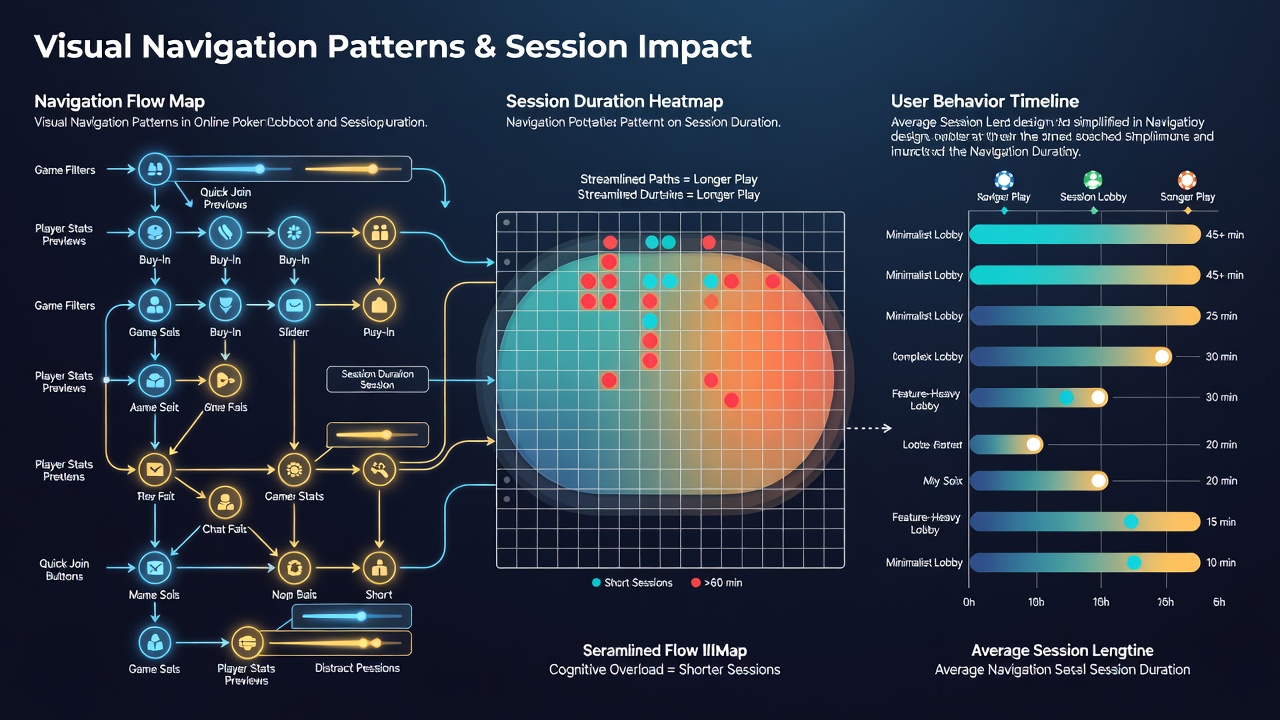
Comparative analysis between desktop and mobile versions further shows that mobile users encounter more friction when menus collapse into icons, leading to longer navigation times and correspondingly shorter overall sessions once play begins. Industry reports from the Canadian Centre for Gaming Research link these interface differences to retention rates, noting that streamlined visual flows support extended engagement while cluttered layouts increase early exits.
Interface Adjustments and Player Behavior Data
Operators who introduced dynamic table highlighting based on stake level and player occupancy observed shifts in navigation patterns during the final quarter of 2026. The highlighting feature reduced the average number of filter interactions by thirty-five percent, and follow-up data indicated that players reached tables more quickly while maintaining comparable total session lengths. Another adjustment involved repositioning the chat and player-count indicators closer to table thumbnails, and logs from that period revealed an increase in multi-tabling behavior among users who previously navigated through separate social panels.
European operators participating in collaborative studies with the European Gaming and Betting Association have tested variations in background shading and button placement, and preliminary figures released in late 2026 suggest that high-contrast action buttons shorten the decision phase between lobby arrival and game entry. These changes do not alter game outcomes yet they modify the temporal distribution of player activity within each visit.
Conclusion
Visual navigation patterns in online poker lobbies function as measurable determinants of session duration because interface layouts shape the speed and sequence of player decisions from initial login through table selection. Data gathered through eye-tracking, clickstream analysis, and platform metrics in October 2026 confirm that streamlined visual flows correlate with quicker entries and sustained play periods, while additional filter interactions or scattered element placement extend lobby time and reduce subsequent engagement length. Continued examination of these patterns across different devices and regions provides operators with concrete indicators for refining lobby designs without modifying underlying game mechanics.